Since the first report of HIV/AIDS in 1981, the battle between humanity and HIV has persisted for over 40 years. Although the widespread adoption of antiretroviral therapy (ART) has transformed HIV infection from a fatal terminal illness into a manageable chronic condition, the continuous evolution of viral drug resistance remains a core challenge urgently needing resolution in the current field of HIV clinical treatment.
In 2024, there were still 40.8 million people living with HIV globally. The latest World Health Organization (WHO) guidelines recommend integrase strand transfer inhibitors (INSTIs) as the core of treatment regimens, among which the second-generation drug Dolutegravir (DTG) has become the first-choice frontline clinical medication due to its robust antiviral efficacy and safety profile. However, with the extensive use of INSTIs, reports of related drug-resistant mutant strains are increasing, and the clinical demand for novel inhibitors with high resistance barriers has never ceased.
Recently, a study published by Jiangsu Aidea Pharmaceutical Co., Ltd. (stock code: 688488.SH) in VIRUSES-BASEL (five-year impact factor 3.7, JCR Q2) [1] disclosed a significant development: the company's self-developed novel INSTI, ACC017 (ASU), demonstrated a unique resistance profile, excellent antiviral activity, and manageable safety, providing a new research direction for resolving HIV drug resistance. The Kunming Institute of Zoology, Chinese Academy of Sciences, served as the corresponding author institution for this study.
Mechanism of Action:
Targeted Inhibition of HIV Integrase to Block Viral Replication
HIV-1 integrase is a critical enzyme in the viral replication cycle, responsible for integrating the viral DNA produced by reverse transcription into the host cell genome. Therefore, the goal of integrase inhibitors is explicit: to sever the integration process and prevent the virus from "settling" within the body.
ACC017 is precisely such a strand transfer inhibitor. The study [1] indicates that ACC017 possesses potent inhibitory activity against wild-type HIV-1 integrase, with a half-maximal inhibitory concentration (IC50) of only 9.19 nM, comparable to the control drug DTG (13.60 nM). It maintains high inhibitory efficiency even against drug-resistant integrase carrying the N155H mutation (IC50 = 9.91 nM).
Molecular docking studies further revealed the details of its action: ACC017 can form various interactions with the integrase active site, including aromatic hydrogen bonds with Tyr143, double salt bridges with Glu152 and Asp116, and π-π stacking with DNA base C20, providing structural theoretical support for its inhibitory activity.
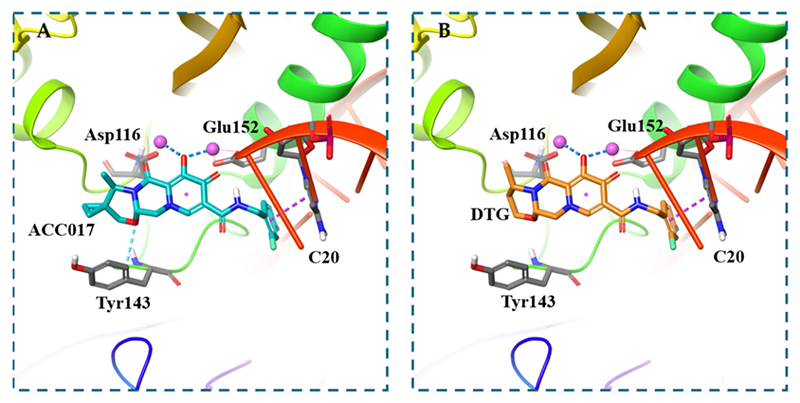
Figure: Molecular docking study. (A) Predicted binding pattern of ACC017 (ASU) to wild-type HIV-1 integrase (PDB ID: 6PUW); (B) Predicted binding pattern of DTG to wild-type HIV-1 integrase (PDB ID: 6PUW). Aromatic hydrogen bonds are shown as light blue dashed lines, salt bridges are shown as dark blue dashed lines, and π–π stacking interactions are shown as purple dashed lines.
In Vitro Activity:
Robust Inhibitory Activity Across Multiple Strains with Minimal Serum Impact
In the antiviral activity assessment, ACC017 demonstrated inhibitory activity against various HIV strains. The core experimental data [1] are as follows:
· Against laboratory-adapted strain HIV-1IIIB: The EC50 was as low as 0.59 nM, with a selectivity index (SI) exceeding 34,525, meaning it effectively inhibits the virus at extremely low concentrations while maintaining high safety for host cells;
· Against drug-resistant strains of different classes: Including NRTI-resistant (HIV-14755-5), NNRTI-resistant (HIV-1A17), and PI-resistant (HIV-1RF/V82F/184V) strains, the EC50 range of ACC017 was only 0.34–9.12 nM, with no significant cross-resistance observed;
· Against clinical isolates: Covering CRF01_AE, CRF07_BC, and CRF01_AE subtypes, the EC50 of ACC017 was as low as 0.11–1.78 nM. Notably, in inhibiting CRF01_AE strains, its activity (EC50 = 1.78 nM) was superior to that of DTG (8.23 nM).
Even in the presence of 20% human serum, the antiviral activity of ACC017 decreased to 1/14 of its original level, while in the same experiment, the activity of DTG dropped to 1/52, suggesting that ACC017 may be less affected by protein binding in vivo.
Resistance Profile:
Unique Mutation Sites Avoiding Classical Resistance "Minefields"
Drug resistance is one of the main bottlenecks in the clinical application of existing INSTI medications. Through gradual increases in drug concentration over 6 months and 13 continuous passages, this study successfully induced an ACC017-resistant strain (HIV-1DRACC017).
Genotypic analysis of the resistant strain revealed a significant discovery: the primary mutation sites induced by ACC017 were D232N and R263K, which persisted from the second passage onward, with mutation frequency gradually increasing across passages. Notably, the study did not detect the G140S/A/C/R or Q148H/R/K mutations common to first- and second-generation INSTIs—sites that are critical to the reduced efficacy of RAL, EVG, and even DTG.
Validation experiments using a constructed R263K single-mutant strain (NL4-3IN-R263K) showed that the EC50 of ACC017 against this strain rose to 28.09 nM (fold change [FC] = 16.52), a magnitude comparable to that of DTG (FC = 13.37). For the G140S/Q148H double-mutant strain, ACC017 maintained effective inhibition (EC50 = 8.19 nM), suggesting it remains active against certain INSTI-resistant strains.
This unique resistance profile implies that ACC017 may address unmet treatment needs following the development of resistance to existing INSTIs and could potentially complement other INSTIs in forming a collective resistance barrier.
R&D Progress:
Phase I/II Study Completed; Phase III Recruitment Underway
Phase I clinical study in healthy subjects and Phase Ib/IIa study in treatment-naïve HIV-infected patients have been completed for ACC017. Patient recruitment for the Phase III study in treatment-naïve HIV-infected patients is now underway.
Disclosed data from Phase Ib/IIa clinical study [2] showed that treatment-naïve participants receiving ACC017 (40 mg) monotherapy for 10 days achieved a mean viral load reduction of 2.34 log10 copies/mL from baseline. Following 18 additional days of combination therapy with a nucleoside backbone (FTC/TAF, 200/25 mg), over 90% of participants achieved complete virological suppression (HIV-RNA < 50 copies/mL). Furthermore, across all dose groups, 100% of participants achieved HIV-RNA < 200 copies/mL after completing the sequential 10-day monotherapy and 18-day combination therapy. Comprehensive study results indicate that ACC017 Tablets possess a favorable safety profile and clear efficacy in monotherapy. When combined with FTC/TAF to form a complete regimen, it achieves high and rapid levels of virological suppression.
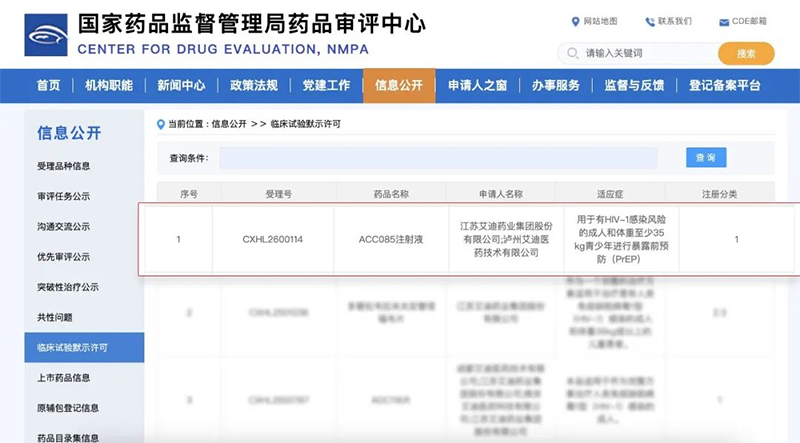
The R&D progress of ACC017 represents a significant breakthrough in China's field of self-developed anti-HIV drugs. Currently, its Phase III clinical study is progressing steadily, and its single-tablet triple regimen, ADC118 Tablets, has also been granted clinical study approval. Furthermore, Aidea Pharma is planning global multicenter clinical studies for its integrase inhibitor, seeking to pursue marketing approvals in both Chinese and U.S. markets to enhance the company's brand influence in the global anti-HIV/AIDS sector.
Over the past 40 years, HIV treatment has evolved from non-existence to a robust therapeutic landscape—advancing from the early "cocktail therapy" to single-tablet regimens, and from daily oral medications to long-acting injections. Every milestone and breakthrough has driven the relentless pursuit of delivering a more convenient, safer, and highly effective treatment experience for people living with HIV. The steady progress of ACC017 is poised to offer broader therapeutic options for HIV-infected individuals, bringing renewed hope particularly to those who have already developed resistance to currently available INSTIs.
References:
[1] Ma MD, Luo RH, Li CY, Huang GC, Long XY, He FY, Yang LM, Fu HL, Zheng YT. Anti-HIV-1 Activity of the Integrase Strand Transfer Inhibitor ACC017. Viruses. 2025 Dec 24;18(1):33. doi: 10.3390/v18010033.
[2] Han, N., Yang, D., Wu, L., Xiao, J., Xiao, L., Liu, Y., Zhou, F., Hu, C., Zhang, F., Qin, H. and Yun, X. (2025), Antiviral Activity, Safety and PK/PD of ACC017 in Antiretroviral Naïve HIV-infected Adults: A Randomized, Double-blind, Placebo/Dose-Parallel-Controlled Short-Term Monotherapy Study. Br J Clin Pharmacol, 2025 Sep 03; 91: 16-16. https://doi.org/10.1002/bcp.70222