


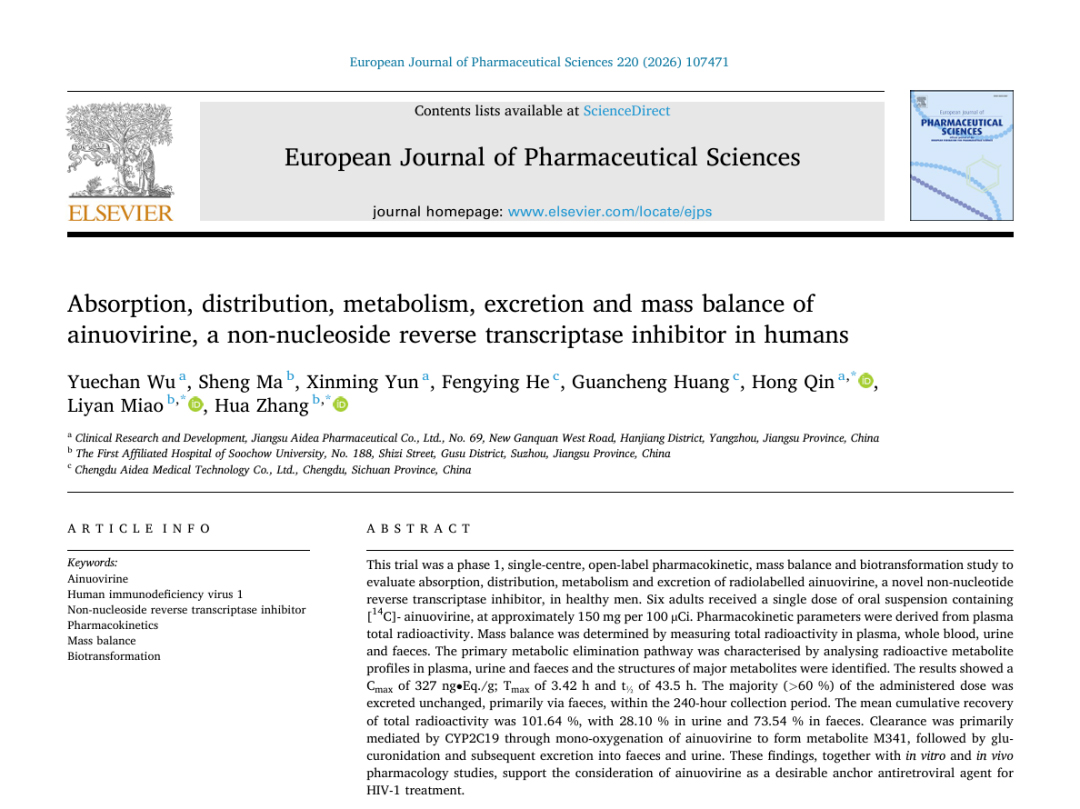
Recently, Jiangsu Aidea Pharmaceutical Group Co., Ltd. (stock code: 688488.SH) announced a major scientific research milestone: the full text of the mass balance study of Ainuovirine (ANV), a next-generation non-nucleoside reverse transcriptase inhibitor (NNRTI) independently developed by the company, has been officially published in the European Journal of Pharmaceutical Sciences (JCR Q1, SCI Impact Factor: 4.7).
Two Core Benefits, Unlocking the Robust Clinical Value of ANV
The research findings published this time[1] bring two major breakthroughs to the clinical application of Ainuovirine:
Decoding the Pharmacological "Black Box", Full-Process Dynamics are Clear and Traceable. The study fully elucidates the entire chain rule of absorption, distribution, metabolism, and excretion (ADME) of Ainuovirine in the human body. Every movement, biotransformation pathway, and clearance method of the drug after entering the human body now has a definitive scientific answer, moving away from the unknown "black box" status and providing solid scientific support for the drug's clinical application.
High Specificity in Metabolic Pathways, Significantly Upgrading the Safety of Combination Regimens. The study demonstrates that Ainuovirine is predominantly metabolized in vivo via the CYP2C19 enzyme. This metabolic pathway possesses high specificity, with an involvement frequency of only 5% to 10% among clinically commonly used medications. This characteristic implies that the risk of drug-drug interactions (DDIs) for Ainuovirine is extremely low. For HIV-infected individuals requiring long-term combination therapy, this not only provides a stronger guarantee for medication safety but also leaves substantial flexible space for the formulation of personalized clinical regimens.
Key Insights at a Glance: Understanding the In Vivo Journey of ANV
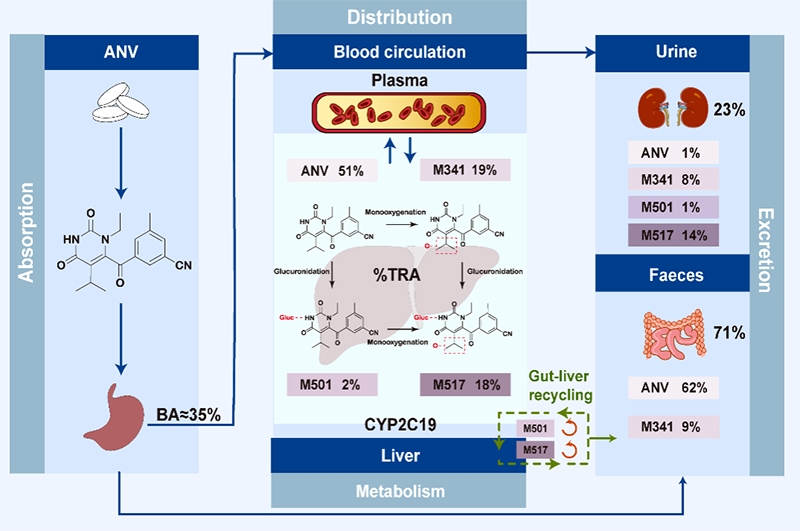
This study was a Phase I, single-center, open-label pharmacokinetic, mass balance, and biotransformation study designed to evaluate the absorption, distribution, metabolism, and excretion of radiolabeled ANV in healthy male subjects. Six adult subjects received a single dose of approximately 150 mg (100 μCi) of [14C]-ANV.
Absorption: The drug was rapidly absorbed with a Tmax of 3.42 h and demonstrated high absorption bioavailability (BA ≈ 35%).
Distribution: Unchanged ANV and three metabolites (with well-defined structures) were identified in the plasma.
Metabolism: ANV is primarily metabolized by CYP2C19. The specific metabolic pathway involves CYP2C19-mediated mono-oxidation to form metabolite M341, followed by glucuronidation to generate M517. The terminal half-life is relatively long (T1/2 = 43.5 h).
Excretion: The mass balance over 240 hours was almost completely recovered (101.64%), with the drug predominantly excreted as the unchanged parent drug via the fecal route (73.54%).
In-Depth Analysis: Deciphering the "Enterohepatic Circulation Puzzle" of ANV In Vivo
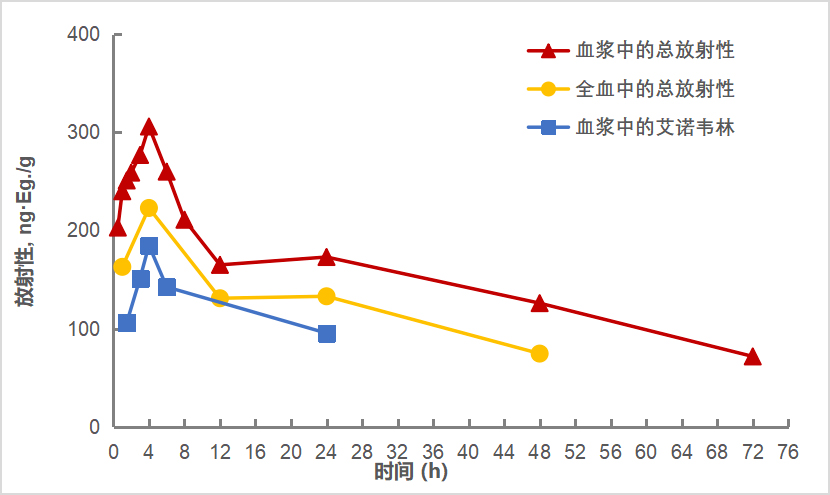
*Total Radioactivity and Ainuovirine in Plasma and Whole Blood
During the study, the team discovered a specific phenomenon worthy of deep investigation: at 24 hours post-dosing, the total radioactivity curves in both the plasma and whole blood of the subjects exhibited a "double-peak" characteristic; however, no "double-peak" performance was observed in the concentration curve of the unchanged ANV in the plasma.
This type of "double-peak" phenomenon is typically explained by enterohepatic circulation—a phenomenon where a portion of the drug excreted into the intestinal tract via bile is reabsorbed in the intestine and returns to the liver via the portal vein, thereby increasing the drug concentration in the systemic circulation.
Based on this, the team proposed two core hypotheses: either the unchanged ANV does not undergo enterohepatic circulation, or the density of the current sampling time points was insufficient to capture the concentration changes of the parent drug. To unravel this riddle, the research team conducted a comprehensive deep dive into the biotransformation pathway of Ainuovirine in the human body:
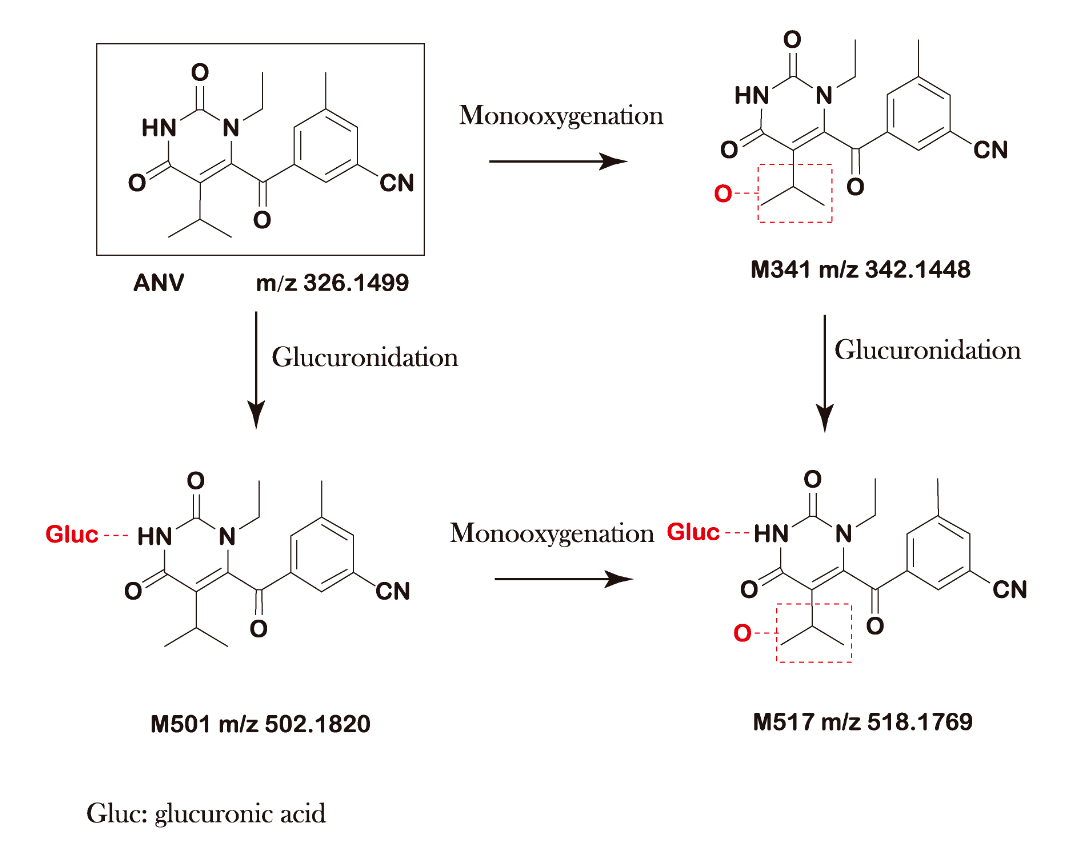
*Proposed Major Biotransformation Pathways of [14C]-ANV in the Human Body
The team detected a total of three metabolites in the human body: M341 derived from the oxidation of ANV, M501 derived from the glucuronidation of ANV, and M517 derived either from the glucuronidation of M341 or the oxidation of M501. These three metabolites, together with the unchanged ANV, jointly contributed to the total radioactivity in plasma and whole blood. Through the analysis of metabolite content across different excretion routes, the team found critical evidence:
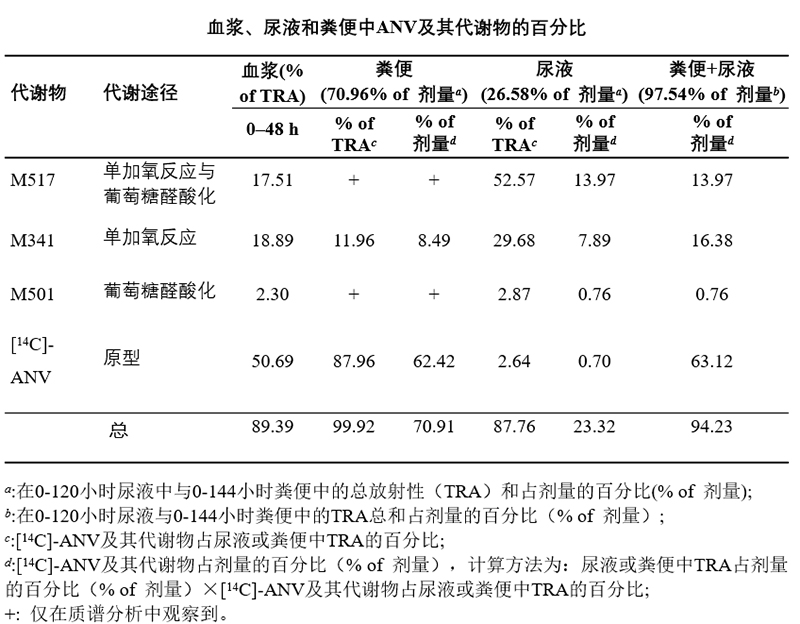
From the perspective of metabolite content, M501 was undetectable in feces and was present only in extremely low amounts in urine (accounting for 0.76% of the dose), indicating that oxidation followed by conjugation is the primary metabolic pathway of ANV. The overall contribution of M501 is limited.
The oxidative conjugation metabolite M517 accounted for 13.97% of the detection in urine but was not detected in feces, indicating that M517 is hydrolytically unstable within the intestinal tract and reverts to M341. It is precisely this process that triggered the enterohepatic circulation phenomenon of total radioactivity.
At this point, the riddle was solved: the unchanged ANV itself does not undergo enterohepatic circulation; rather, its metabolite M517 undergoes hydrolysis to revert to M341, which then triggers enterohepatic circulation, ultimately forming the unique phenomenon of "double peaks present in total radioactivity, but absent in the unchanged drug".
This study clarifies the entire process of absorption, distribution, metabolism, and excretion of Ainuovirine in the human body, comprehensively elucidating the drug disposition patterns in humans. These key scientific research data not only complete the puzzle of Ainuovirine's pharmacokinetic characteristics but also lay a solid scientific foundation for rational clinical drug use and patient safety assurance. This will assist clinicians in formulating more precise and safer medication regimens, maximizing clinical benefits for patients while minimizing medication risks to the greatest extent possible.
References:
Wu Y, Ma S, Yun X, He F, Huang G, Qin H, Miao L, Zhang H. Absorption, distribution, metabolism, excretion and mass balance of ainuovirine, a non-nucleoside reverse transcriptase inhibitor in humans. Eur J Pharm Sci. 2026 Feb 12; 220: 107471. doi: 10.1016/j.ejps.2026.107471.


 ®Selected for Oral Presentations at the International Workshop on Women & HIV">